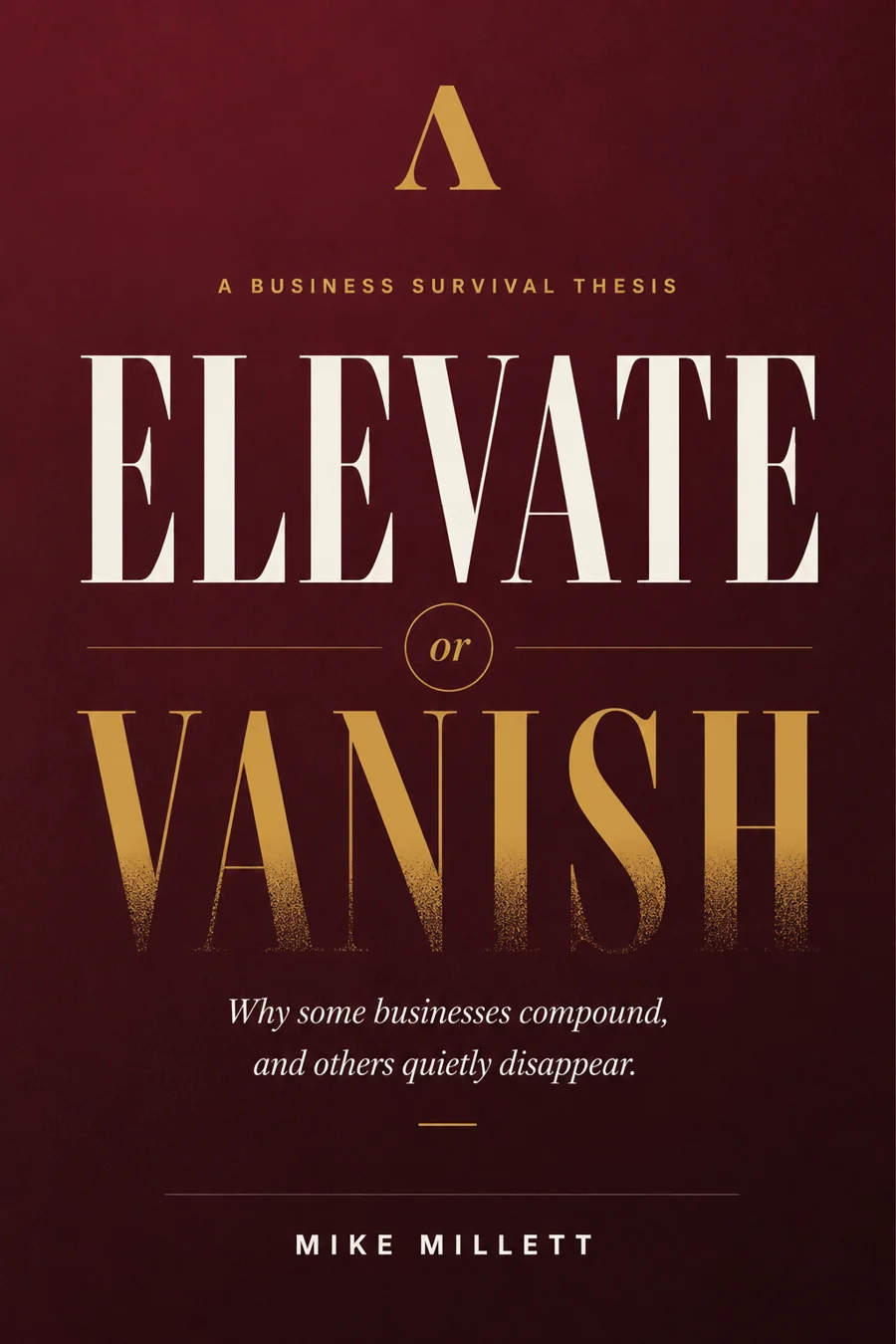
Execution keeps getting cheaper. Responsibility does not. That is the whole difference, and I found it by doing the wrong thing first.
Chapter 34
Somebody Has to Say No
I worked with Nick Vujicic, and the most useful thing I did for him was stop things.
For anybody who does not know Nick: he was born without arms or legs, he speaks to stadiums, and he is one of the most magnetic people I have ever been in a room with. Within about four minutes you stop registering the disability entirely, which is a sentence I know sounds like a line and is simply what happens.
Because he is magnetic, people constantly arrive with ideas.
Some were good. A lot were stunts. Somebody wanted to put him in the overhead compartment on a plane and film it. There was always another version of that, always presented with real enthusiasm, always by somebody who genuinely liked him and could see how well it would do.
And they were right that it would do well. That is the difficult part. The stunts were not bad ideas in the sense of not working. They would have worked. They would have got the numbers.
My job, on those days, was to be the person in the room who said that will hurt the brand.
That is what brand management actually is, and I want to be honest that it is unglamorous and that nobody thanks you for it in the moment. It is not campaigns. It is not clever. It is sitting in a room where everybody is excited, and being the one who says that in ten years this will be the thing people remember, and it will be the wrong thing, and we cannot get it back.
You are trading something measurable and immediate against something unmeasurable and distant, in front of people who can see the first and have to take the second on faith. You lose that argument regularly. You have to keep having it.
Here is the underlying idea and it took me years to be able to state it: a brand has a core that must stay stable, and an execution layer that should change constantly. Almost everybody gets that backwards. They keep the tactics they are used to and let the core drift, one reasonable exception at a time, until the thing people trusted is not there any more and nobody can point to the day it left.
Nick's core was never in question. What he stood for was fixed. So the whole job was making sure that nothing in the execution, however good it looked that week, quietly rewrote it.
I am not going to claim credit for who Nick is. He was who he was long before I was anywhere near him. What I will claim is that I understand what the job is, because I did it for somebody where the cost of getting it wrong was a real person's life's work rather than a quarter's numbers.
Chapter 35
AI Optimized the Wrong Thing
I found it by searching Google for my own work.
I do that periodically, partly to check what the machines are saying about us and partly out of vanity, and this time something was wrong. A paper I had written, sixteen pages on a subject I care about, was no longer where I had published it. The address I typed sent me somewhere else. To my own company's site, in fact, onto a commercial page, which is not where a paper belongs.
The AI system I work with had done it. It had seen a real problem and applied a real fix.
The problem was genuine. Two of my own domains were holding the same term at the same address. One of them, Marketing Helix, is where the thinking lives: the research, the definitions, the history, the argument, written under my name. The other, Digilu, is the company, where you go if you want somebody to actually do the work. Two properties, two different jobs.
Continue this chapter in the free book →
Chapter 36
What Does Not Get Cheap
Here is what I think is actually happening, and it is not really about AI.
Execution keeps getting cheaper. It has done it four or five times in my working life, and each time the same people say the same thing about how this one is different, and each time the specialists who were paid for the doing have to find something else to be.
I knew that. I have taught it. And when I restarted my own company, I built.
Websites, tools, engines, frameworks, dashboards, domains. All of it defensible, most of it good, and every bit of it an answer to the question of what I know how to make rather than the question of what remains valuable when making things is easy.
Continue this chapter in the free book →
Chapter 37
The Six Stages
So I built the thing I had been describing, and I want to put it here plainly rather than leave it as an idea.
Observation is only useful when somebody is responsible for the response.
That sentence took me an embarrassing number of years and one failed dashboard project to arrive at. You can watch everything. You can have every number on one screen, updating live, beautifully arranged. If nobody owns what happens next, you have built a very expensive way to be informed about your own decline.
What it watches is not exotic. Search, because that is still where most people start. AI answers, because that is increasingly where they finish. Reviews, because that is the trust signal people and machines are both reading. Reputation more broadly, meaning what is being said in places you do not control. Competitors, because your position is relative and always was. And the health of your own site, because the most common reason a business is not being found is something boring and fixable.
Continue this chapter in the free book →
Chapter 38
The Part That Is Actually Leadership
Every transformation I have watched needed one thing that no amount of analysis supplies, which is somebody willing to act before it was obvious that action was required.
Continue this chapter in the free book →
Chapter 39
The Business Cards I Will Probably Never Use
I have spent real time designing business cards I am almost certainly never going to hand out.
Continue this chapter in the free book →
Chapter 40
I Always Got Her a Friend
At every campsite we stopped at as children, I would go off and find myself a friend. I was good at it. I have never found it difficult to walk up to somebody and start talking, and at six I did not yet know that was unusual.
Continue this chapter in the free book →
Chapter 41
What I Actually Do First
People ask me what I would look at first, and my answer has got less impressive over the years.
Continue this chapter in the free book →
Chapter 42
Slow, and Then All at Once
Almost nothing disappears suddenly.
Continue this chapter in the free book →
That is a preview of Part Six.
The digital edition is free. Read substantial excerpts here or download the complete book. No email, no gate, nothing to sign up for.
Continue reading in the free book ↓